1,过去式
Yesterday I ___ to the park.
参考答案与解析
B. went
yesterday 表过去,go 的过去式是 went。

本页主题:A trip to the cinema · 一次电影院之行。结合对话改错与故事填空,学会描述过去经历,并区分现在的喜好。先独立作答,再对照讲解检查。
能用一般过去时描述昨天的活动;能根据 Did / Was 选择正确简答;能区分过去经历与现在喜好;能结合上下文、词性和时态完成叙事填空。
学习提示:先找时间,再看句式;先判断词性,再结合语境。不要看到 yesterday 就把整页所有动词都改成过去式。
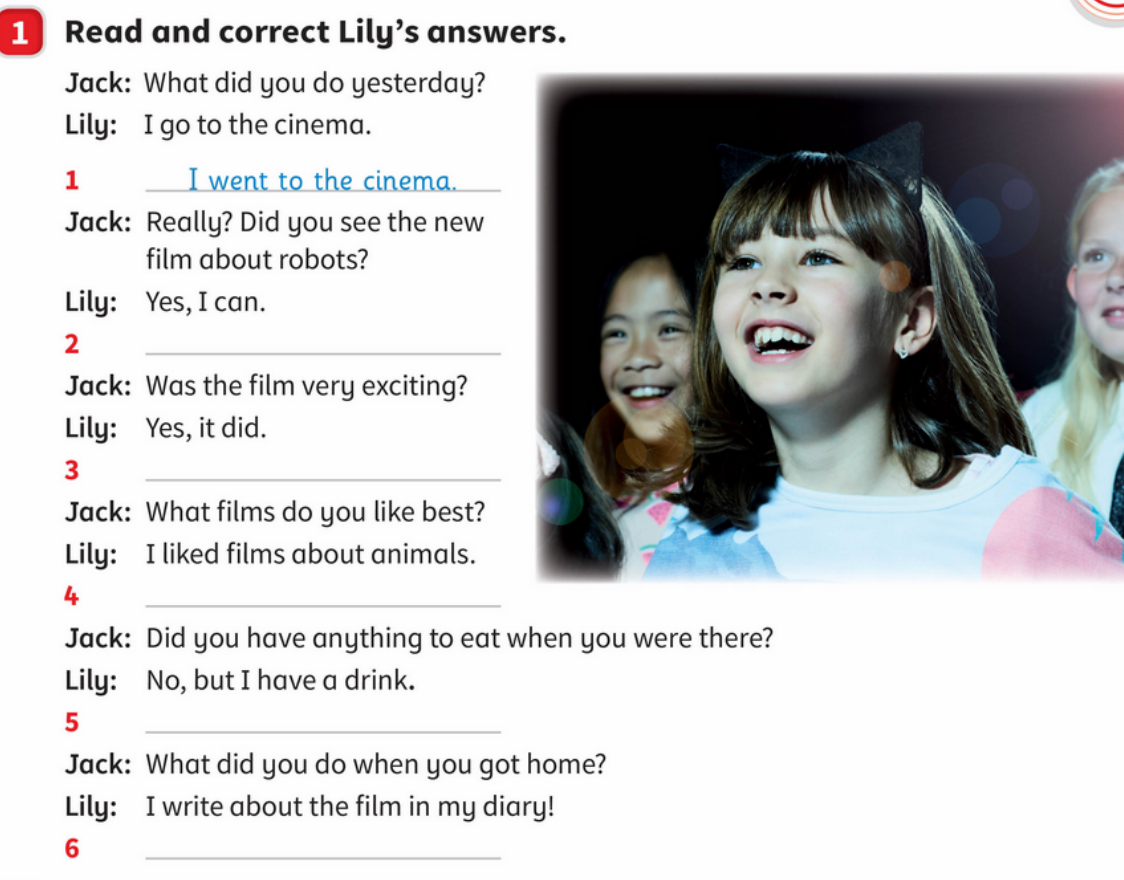
读对话,改正 Lily 的回答。共6处,其中第1处为原页示例。
Jack: What did you do yesterday? 你昨天做了什么?
Lily 原答: I go to the cinema.
改正: I went to the cinema. 我去看电影了。
考点: 用过去式回答过去的活动。语法: 特殊疑问句为 What + did + 主语 + 动词原形;肯定回答为 主语 + 动词过去式。did 已标记过去,问句 do 不变成 did;回答中没有助动词 did,实义动词 go 要变 went。
易错: What did you went…? ×;I did went… ×。正确是 What did you do…? / I went…。
拓展: go—went;go to the cinema 去看电影;go home 回家,home 前不加 to。I went to the park yesterday. 昨天我去了公园。
Jack: Really? Did you see the new film about robots? 真的吗?你看了那部关于机器人的新电影吗?
Lily 原答: Yes, I can.
改正: Yes, I did. 是的,我看了。
考点: 一般过去时的一般疑问句与简短回答。语法: Did + 主语 + 动词原形…? → Yes, 主语 + did. / No, 主语 + didn't. 问经历是否发生,不是问有没有能力。
易错: can 是能力或许可,不与此处 Did 对应。Did you saw…? ×;Did you see…? ✓。
拓展: 完整答句是 Yes, I saw it.;否定是 No, I didn't see it.。see—saw;a film about robots 一部关于机器人的电影。
Jack: Was the film very exciting? 那部电影很精彩吗?
Lily 原答: Yes, it did.
改正: Yes, it was. 是的,很精彩。
考点: be 动词过去式的问答。语法: Was + 单数主语 + 形容词…? → Yes, it was. / No, it wasn't. film 用 it 回指。这里 exciting 描述电影的特点,谓语核心是 was。
易错: 不把 was 问句答成 did,也不写 Did the film was exciting?。注意 Were the films exciting? → Yes, they were.。
拓展: The film was exciting. 电影令人兴奋。I was excited. 我很兴奋。exciting 通常描述引起兴奋的事物;excited 描述感到兴奋的状态。不要机械记成“所有 -ed 都只能修饰人”。
Jack: What films do you like best? 你最喜欢什么样的电影?
Lily 原答: I liked films about animals.
改正: I like films about animals. 我喜欢关于动物的电影。
考点: 一般现在时表达当前喜好。语法: 问句 do you like 指通常的喜好,回答用 like。此处不能因为前文 yesterday 就机械使用 liked。
易错: liked 语法上可以讲过去喜好,但不符合这道题直接回答“现在喜好”的目标。liked 可以表达过去的喜好,但这里问的是现在。
拓展: I like animal films best. 我最喜欢动物电影。What film did you like best yesterday? 昨天你最喜欢哪部电影?此时回答才用 I liked…。
Jack: Did you have anything to eat when you were there? 你在那里时吃了什么东西吗?
Lily 原答: No, but I have a drink.
改正: No, but I had a drink. 没有,不过我喝了一杯饮料。
考点: 过去活动与上下文一致。语法: have—had;问句 Did you have…? 中用原形 have,回答的肯定分句用 had。No 表示没吃东西,but 补充喝了饮料,并不矛盾。
易错: I did had a drink ×;I had a drink ✓。不能因为 No 就把后面的喝饮料也改成否定。
拓展: anything to eat 一些吃的东西;something to drink 一些喝的东西。to eat / to drink 在此修饰前面的不定代词。疑问/否定中常用 anything,肯定中常用 something,但礼貌请求或期望肯定回答时也可用 something:Would you like something to drink?。
when 从句: when you were there 表“你在那里的时候”,you 与 were 对应。讲过去经历,主从句按过去语境选择时态,不套“主将从现”。
Jack: What did you do when you got home? 你回家后做了什么?
Lily 原答: I write about the film in my diary!
改正: I wrote about the film in my diary! 我在日记里写了那部电影!
考点: 不规则动词过去式与过去叙事。语法: write—wrote;get—got;when you got home 是时间状语从句,说明后面的行动发生在什么时间。
易错: writed ×;wrote ✓。in my diary 表“在我的日记里”,不是 on my diary。write about + 主题,表示写有关……的内容。
拓展: I wrote about my school trip in my diary. 我在日记里写了学校旅行。write—wrote—written,第三个形式为认识性拓展,本题只需过去式。
| 题号 | 参考答案 | 核心判断 |
|---|---|---|
| 1(示例) | I went to the cinema. | yesterday → go 的过去式 went |
| 2 | Yes, I did. | Did 提问用 did 回答 |
| 3 | Yes, it was. | Was 提问用 was 回答 |
| 4 | I like films about animals. | 目前喜好,用一般现在时 |
| 5 | No, but I had a drink. | 昨天的喝饮料,用 had |
| 6 | I wrote about the film in my diary! | write 的过去式 wrote |
| 句式 | 结构 | 本课例句 |
|---|---|---|
| 过去肯定句 | 主语 + 过去式 | I went to the cinema. |
| 过去否定句 | 主语 + didn't + 原形 | I didn't see the film. |
| 过去一般疑问句 | Did + 主语 + 原形…? | Did you see the film? |
| 过去特殊疑问句 | 疑问词 + did + 主语 + 原形…? | What did you do? |
| be 动词过去句 | 主语 + was/were + 表语 | The film was exciting. |
| 情态动词句 | could/couldn't + 原形 | We couldn't decide. |
| 现在喜好 | 主语 + like/likes… | I like animal films. |
记忆线索: did 后回原形,肯定句看过去式;was/were 自成一组;could 后也用原形;先读时间与句意,再做形式变化。
Yesterday I ___ to the park.
B. went
yesterday 表过去,go 的过去式是 went。
—Did you watch the film? —Yes, I ___.
C. did
Did 提问,用 did 简答。
—Was the film exciting? —Yes, it ___.
A. was
Was 提问,用 was 回答。
—What films do you like best? —I ___ animal films.
D. like
当前喜好用一般现在时,I 对应 like。
Did you ___ a drink yesterday?
B. have
Did 后接原形 have。
I ___ about the trip in my diary last night.
C. wrote
write 的过去式是 wrote,不是 writed。
The film was ___. We felt excited.
D. exciting
电影令人兴奋用 exciting;人感到兴奋用 excited。
改为否定句:I saw the film yesterday.
I didn’t see the film yesterday.
didn’t 后 saw 还原 see。
改为一般疑问句:They were happy.
Were they happy?
be 动词 were 提到句首;不额外加 did。
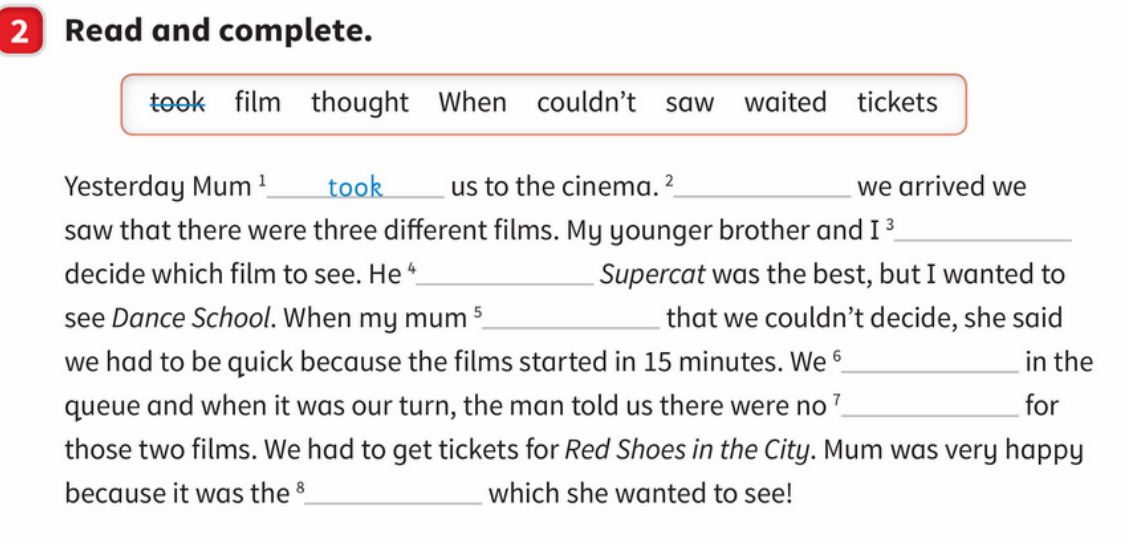
读短文,用词框里的词填空。词框:took(示例)、film、thought、When、couldn't、saw、waited、tickets。每词使用一次;共8空,包含第1空示例。
Yesterday Mum took us to the cinema. When we arrived we saw that there were three different films.
昨天妈妈带我们去了电影院。我们到达时,看见有三部不同的电影。
My younger brother and I couldn't decide which film to see. He thought Supercat was the best, but I wanted to see Dance School.
我和弟弟无法决定看哪部电影。他觉得《Supercat》最好,但我想看《Dance School》。(片名保留原文,不猜官方译名。)
When my mum saw that we couldn't decide, she said we had to be quick because the films started in 15 minutes.
妈妈看到我们无法决定时,她说我们得快一点,因为电影还有15分钟就开场了。
We waited in the queue and when it was our turn, the man told us there were no tickets for those two films.
我们排队等候。轮到我们时,那位男士告诉我们,那两部电影已经没有票了。
We had to get tickets for Red Shoes in the City. Mum was very happy because it was the film which she wanted to see!
我们只好买《Red Shoes in the City》的票。妈妈非常开心,因为这正是她想看的电影!
Yesterday Mum took us to the cinema.
考点: 动词时态与固定搭配。语法: yesterday 明确过去,take 的过去式为 took;take + 人 + to + 地点,表示带某人去某处。us 为宾格,作 took 的宾语。
易错: taked ×;took ✓;took we ×;took us ✓。不要把 bring 与 take 简单当成完全相同的词,方向取决于说话位置与视角。
拓展: Dad took me to the museum. 爸爸带我去了博物馆。take—took—taken,taken 为认识性补充。
When we arrived we saw that there were three different films.
考点: 根据句子逻辑选择连接词。语法: When + 主语 + 谓语,说明“当我们到达时”;句首大写。书写时也可加逗号:When we arrived, we saw…。
易错: 不能凭 yesterday 一直选动词过去式;此处空后已有完整主谓 we arrived,需要连接词。arrive 后没有地点时可以单独使用,不必添 to。
拓展: arrive at the cinema 到电影院;arrive in London 到伦敦;arrive home 到家(不加 at)。
My younger brother and I couldn't decide which film to see.
考点: 结合后文无法达成决定的语义选否定。语法: couldn't = could not,是 can 的过去形式之一;couldn't + 动词原形 decide。which film to see 为“疑问词 + 名词 + to do”,意为“看哪部电影”。
易错: couldn't decided ×;couldn't decide ✓。不能只背 could 表过去,漏掉 not 带来的“不能”。
拓展: I don't know what to do. 我不知道做什么。She knows how to get there. 她知道怎么去那里。此类结构不是一个带独立主谓的完整从句。
He thought Supercat was the best, but I wanted to see Dance School.
考点: 过去的想法及转折关系。语法: think—thought;thought 后接省略 that 的宾语从句 Supercat was the best;the best 是 good 的最高级形式。
易错: thinked ×;thought ✓。but 表弟弟与“我”的选择不同。这里没有说弟弟认为这部电影“客观上一定最好”,只是在转述他的判断。
拓展: good—better—best;I thought the story was funny. 我觉得那个故事很有趣。want to see 想看,to 后用动词原形。
When my mum saw that we couldn't decide, she said we had to be quick because the films started in 15 minutes.
考点: 叙事过去式与上下文照应。语法: see—saw;saw that… 表“看到/意识到……”,that 从句说明看到的内容。开头 When 引导时间状语从句,because 引导原因状语从句。
易错: saw 后不是所有动词都直接用原形;本句是 saw + that 从句,不能按 see somebody do 的结构处理。couldn't decide 中 decide 为原形,是 could 的要求。
拓展: she said we had to be quick 是 said 后的宾语内容;had to 表过去“不得不/必须”。本句不是“have + 过去分词”的完成时。
时间表达: in 15 minutes 从当时的时间点往后数15分钟;结合 she said 的过去叙事,可译为“再过15分钟”。不要误译为“15分钟前”,那是 15 minutes ago。
We waited in the queue and when it was our turn…
考点: 规则动词过去式与搭配。语法: wait + ed → waited,意为等候;wait in the queue 排队等候;it was our turn 轮到我们了。
易错: queue 中多个字母不逐一发音,读 /kjuː/;wait 的 -ed 在 /t/ 后读 /ɪd/,waited /ˈweɪtɪd/。不要把所有 -ed 都读成 /ɪd/。
拓展: wait for somebody 等某人;wait in a queue 排队等候;take turns 轮流。We waited for our teacher. 我们等老师。
…the man told us there were no tickets for those two films.
考点: 词性、单复数与上下文。语法: there were 表过去有;no tickets 表没有票;tickets 为名词复数,且与 for those two films 自然搭配。
易错: there was no tickets ×;there were no tickets ✓。told us 后的内容说明售票员告知什么,不是 told we。
拓展: There were no tickets. = There weren't any tickets. 没有票了。a ticket for the film 一张电影票;a ticket to London 一张去伦敦的票。
Mum was very happy because it was the film which she wanted to see!
考点: 名词选择与前后照应。语法: it was the film 中 film 为单数;which she wanted to see 是修饰 film 的定语从句,which 在从句中作 see 的宾语。
易错: which 不是修饰 wanted,也不是“在哪儿”;这里不能用 where 代替。不要写成 the film which she wanted to see it,避免宾语重复。
拓展: 此处 which 可用 that 替换,也可省略:the film (which/that) she wanted to see。先理解“她想看的那部电影”,再观察 which 如何把两部分连起来。
| 空号 | 答案 | 判断依据 |
|---|---|---|
| 1(示例) | took | yesterday;take us to… |
| 2 | When | 连接到达与看到,句首大写 |
| 3 | couldn't | 无法决定;后接 decide 原形 |
| 4 | thought | 他认为;think 的过去式 |
| 5 | saw | 妈妈看到;see 的过去式 |
| 6 | waited | 排队等候;wait 的过去式 |
| 7 | tickets | there were no;电影票复数 |
| 8 | film | the film which she wanted to see |
| 单词原形/词组(本页形式) | 英式音标 | 词性 | 中文意思 | 英语例句 |
|---|---|---|---|---|
| go(went) | /ɡəʊ/ | 动词 | 去 | We went to the cinema. |
| see(saw) | /siː/ | 动词 | 看见;观看 | I saw a film yesterday. |
| have(had) | /hæv/ | 动词 | 有;吃喝 | I had a drink. |
| write(wrote) | /raɪt/ | 动词 | 写 | I wrote in my diary. |
| take(took) | /teɪk/ | 动词 | 带;拿 | Mum took us to the cinema. |
| think(thought) | /θɪŋk/ | 动词 | 想;认为 | I thought it was funny. |
| tell(told) | /tel/ | 动词 | 告诉 | She told us the story. |
| say(said) | /seɪ/ | 动词 | 说 | He said hello. |
| get(got) | /ɡet/ | 动词 | 到达;得到 | I got home at five. |
| decide | /dɪˈsaɪd/ | 动词 | 决定 | We couldn't decide. |
| arrive | /əˈraɪv/ | 动词 | 到达 | We arrived early. |
| wait(waited) | /weɪt/ | 动词 | 等候 | We waited in a queue. |
| cinema | /ˈsɪnəmə/ | 名词 | 电影院 | The cinema is near my home. |
| film | /fɪlm/ | 名词 | 电影 | The film was exciting. |
| ticket | /ˈtɪkɪt/ | 名词 | 票 | I bought two tickets. |
| queue | /kjuː/ | 名词 | 队伍 | We stood in the queue. |
| diary | /ˈdaɪəri/ | 名词 | 日记;日记本 | This is my diary. |
| exciting | /ɪkˈsaɪtɪŋ/ | 形容词 | 令人兴奋的 | It was an exciting game. |
| different | /ˈdɪfrənt/ | 形容词 | 不同的 | We chose different films. |
| turn | /tɜːn/ | 名词(本课义) | 轮到的机会 | It is your turn. |
| younger | /ˈjʌŋɡə/ | 形容词比较级 | 较年幼的 | My younger brother is six. |
| couldn't | /ˈkʊdnt/ | 情态动词否定缩写 | 不能(过去语境) | I couldn't open the box. |
词组: take somebody to… 带某人去……;write about… 写有关……;in my diary 在日记里;wait in a queue 排队;have to do 不得不做;want to do 想做;it is one's turn 轮到某人。
时间线: yesterday → arrived → couldn't decide → waited → got tickets。复述时用过去式串起经历。
because 给原因: Mum was happy because she wanted to see that film. 妈妈高兴,因为她想看那部电影。but 表转折: My brother wanted one film, but I wanted another. 弟弟想看一部,我想看另一部。when 交代时间: When we arrived, we joined the queue. 我们到达后就去排队。
三种从句不要混淆: When we arrived… 说明时间;we saw that there were three films 中 that 后是看到的内容;the film which she wanted to see 中 which 从句修饰 film。都出现两个谓语,不代表都是同一种从句。
词义拓展: film 与 movie 都可指电影;本讲义沿用教材 film 与英式 queue。先读懂句意,再结合例句认识不同结构。
第2题提示:两个孩子想看的电影不同。
We couldn’t ___ which film to see.
A. decide
couldn’t 后用原形 decide。
Mum took ___ to the cinema.
D. us
动词 took 后用宾格 us。
There ___ no tickets for the film yesterday.
B. were
tickets 复数,过去存在句用 were。
Mum was happy ___ she liked that film.
C. because
后句说明开心的原因,用 because。
___ we arrived, we joined the queue.
A. When
When 引导时间状语从句,表示到达时。
用 when 写一句过去发生的事,两个分句都要有主语和谓语。
When I got home, I wrote in my diary.
开放题,多种答案成立;注意过去语境和完整结构。
写2句:一句描述昨天的活动,一句描述现在的喜好。
I watched a film yesterday. I like animal films.
第一句过去活动用过去式;第二句当前喜好用现在时。
作答只保存在当前浏览器。开放题请对照答案自查。