
免费公开课 · POWER UP 3 · P26–27 · TRACK 1.28
The old man and the small fish老人与小鱼
Power Up 3第26、27页
学习目标:理解故事中的人物与两层情节;区分日常习惯与过去事件;掌握didn’t+动词原形;用英语表达对熟悉生活与新尝试的看法。
01教材原图与逐句双语听读
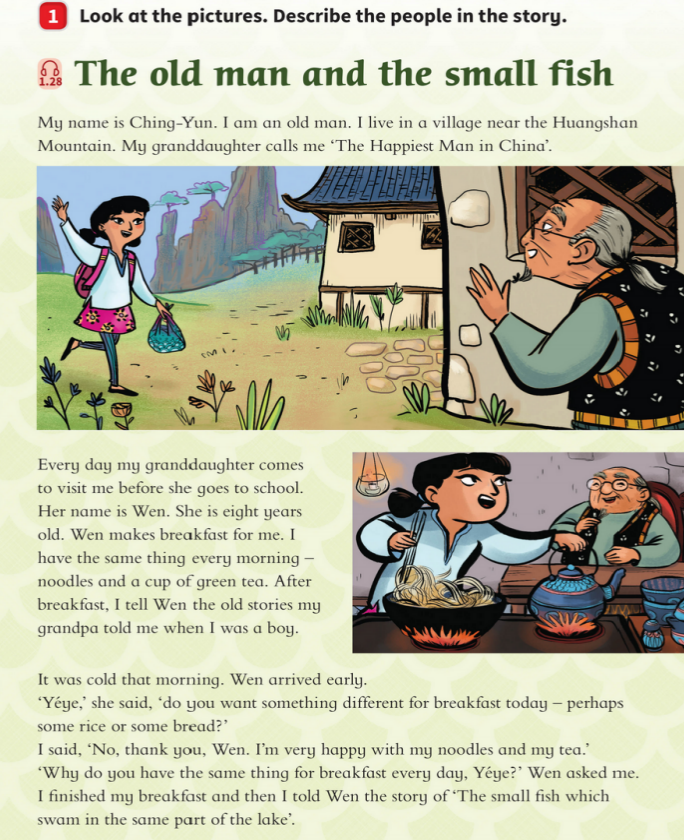
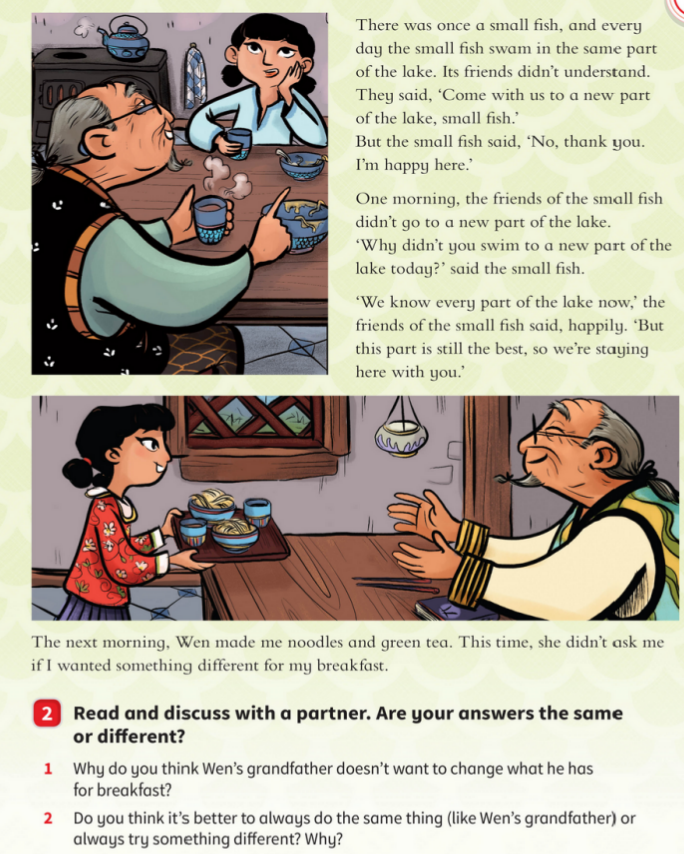
教材1.28原声录音位于完整双语课文下方。以下逐句点击功能仍使用设备英语合成朗读,音色与可用性由设备决定。
点击任意句子朗读。全文朗读按故事顺序进行。
02新单词列表
英式音标;词组、例句为教学整理。人名保留教材拼写。先回忆再看中文;错词与到期复习记录只保存在当前浏览器。
本课词汇
点击喇叭听单词。朗读使用设备英语语音,音色因设备而异。
village
村庄
He lives in a village.
granddaughter
孙女;外孙女
His granddaughter visits him.
call
称呼;叫
My friends call me Wen.
happy
(最高级 happiest)
快乐的
She is happy here.
visit
看望;参观
I visit my grandpa every day.
before
在……之前
I eat before I go to school.
noodle
(课文 noodles)
面条
I like noodles for breakfast.
a cup of
一杯……
He has a cup of tea.
green tea
绿茶
Grandpa likes green tea.
tell
(过去式 told)
讲述;告诉
Please tell me a story.
story
(复数 stories)
故事
This is an old story.
arrive
(过去式 arrived)
到达
We arrive early.
early
早;提早
She comes early.
something
某事;某物
I want something different.
different
不同的
We like different foods.
perhaps
也许
Perhaps he wants bread.
finish
(过去式 finished)
完成;吃完
I finish my breakfast.
once
从前;曾经
There was once a small village.
swim
(过去式 swam)
游泳
Fish swim in the lake.
same
相同的
We like the same story.
part
部分;区域
This part of the lake is quiet.
lake
湖
There is a lake near my home.
understand
理解
I understand the story.
know
知道;了解
We know this village.
happily
高兴地
She smiled happily.
still
仍然
He is still happy here.
good
(最高级 best)
好的
This is a good place.
stay
留下;停留
We want to stay here.
make
(过去式 made)
制作;做
I make breakfast for Mum.
ask
问
Can I ask you a question?
03重点词组与表达
come to visit me
My friends come to visit me.
来看我;come to+动词原形表示来做某事
make breakfast for me / make me breakfast
Wen makes breakfast for her grandpa.
给我做早餐;两种宾语结构
the same thing / the same part of the lake
We read the same book.
同样的东西/湖里同一个区域;same前通常用the
be happy with …
I am happy with my breakfast.
对……满意
tell somebody a story
Grandpa tells me a story.
给某人讲故事
something different
Let’s try something different.
不一样的东西;形容词置于something后
come with us
Come with us to the park.
和我们一起来;介词with后用宾格us
stay here with you
I want to stay here with you.
留在这里和你在一起
重点句型:观察 → 理解 → 替换
My granddaughter calls me ‘The Happiest Man in China’.
call+宾语+称呼:称呼某人为……。My friends call me Lily. 我的朋友叫我莉莉。
I’m very happy with my noodles and my tea.
be happy with+事物:对……满意。I’m happy with my lunch. 我对午餐很满意。
Why didn’t you swim to a new part of the lake today?
Why didn’t+主语+动词原形:为什么过去没做……?Why didn’t you come yesterday? 你昨天为什么没来?
This part is still the best, so we’re staying here with you.
原因+so+结果。It’s cold, so we’re staying at home. 天冷,所以我们要待在家里。
即刻练习:用call、be happy with各说一句;将Why didn’t you went?改正。参考:My friends call me Tom. I’m happy with my breakfast. Why didn’t you go?
04语法总结与易错点
一般现在时与一般过去时:先分清叙述层次
Wen makes breakfast for me. / Wen arrived early.
开头介绍日常习惯,用一般现在时;that morning引出过去的具体事件,用一般过去时。对话中的现在时从说话当时出发,不要把全文统一改成过去时。
✗ Wen make breakfast every day. → ✓ Wen makes breakfast every day.
didn’t与过去时疑问句
Why didn’t you swim to a new part of the lake today?
Why+didn’t+主语+动词原形?询问过去为什么没做某事。did已承担过去时,后面的swim、go、ask保持原形。
✗ didn’t swam → ✓ didn’t swim;✗ didn’t went → ✓ didn’t go。
不规则过去式
swam / said / told / made / was
swim→swam;say→said;tell→told;make→made;am/is→was。规则变化:arrive→arrived;finish→finished。
✗ swimmed → ✓ swam;✗ maked → ✓ made。
不定代词与形容词
Do you want something different …?
something+形容词,表示某种……的东西。本句疑问是在提出建议、询问是否想要某物,something可以用于此类疑问句。
✗ different something → ✓ something different;不要说疑问句必须用anything。
时间状语从句:before / when
… before she goes to school. / … when I was a boy.
before+完整句子:在……之前;when+完整句子:当……时。After breakfast中的after后接名词,是介词用法。
✓ before she goes;✓ when I was a boy;结合时间与主语判断动词形式。
定语从句:which作主语;关系词作宾语时可省略
The small fish which swam in the same part of the lake / the old stories my grandpa told me
which swam …修饰fish,which作从句主语,不能直接省略。my grandpa told me修饰stories,stories是told的直接宾语,可理解为省略了that/which;me是间接宾语。
✗ the fish swam …(想表达一个含定语从句的名词短语时)→ ✓ the fish which swam …;不是所有关系词都能省略。
if引导宾语从句:是否
… she didn’t ask me if I wanted something different …
if在这里表示“是否”,引导ask的内容;从句使用陈述语序I wanted。不是“如果”的条件状语从句。wanted与过去叙述呼应。
✗ asked me if did I want … → ✓ asked me if I wanted …。
最高级、形容词与副词
The Happiest Man in China / this part is still the best / said, happily
happy→happier→happiest;good→better→best。happy描述人或状态;happily修饰said。The Happiest Man是孙女对爷爷的称呼,不是全国统计结论。
✗ said happy → ✓ said happily;✗ the goodest → ✓ the best。
现在进行时表示当前安排
… so we’re staying here with you.
be+动词-ing。本句表达朋友们决定留在这里的安排,不等于“永远住在这里”。so连接结果,but表示转折。
✗ we staying → ✓ we’re staying;stay→staying。
05阅读理解与巩固练习
1. Where does Ching-Yun live?
查看参考答案与解析
In a village near the Huangshan Mountain.
按课文定位地点。
2. How old is Wen?
查看参考答案与解析
She is eight years old.
数字eight来自原文。
3. What does he have for breakfast every morning?
查看参考答案与解析
Noodles and a cup of green tea.
注意a cup of。
4. Who told Ching-Yun the old stories when he was a boy?
查看参考答案与解析
His grandpa.
区分现在讲故事的爷爷与他小时候的爷爷。
5. Why did the friends decide to stay in the same part of the lake?
查看参考答案与解析
Because they knew every part of the lake and thought this part was still the best.
参考答案用过去时转述;直接引用原文现在时也可。
6. What does “Its” in “Its friends” refer to?
查看参考答案与解析
The small fish.
its是物主限定词;it’s才是it is等的缩写。
7. 用一般现在时填空:Wen ___ (make) breakfast for her grandpa every day.
查看参考答案与解析
makes
Wen为第三人称单数。
8. 用一般过去时填空:The small fish ___ (swim) in the lake that morning.
查看参考答案与解析
swam
swim的不规则过去式。
9. 改错:They didn’t went to a new part of the lake.
查看参考答案与解析
They didn’t go to a new part of the lake.
didn’t后用原形。
10. 选择:Do you want (different something / something different)?
查看参考答案与解析
something different
形容词后置。
11. 选择:The friends said (happy / happily).
查看参考答案与解析
happily
修饰said用副词。
12. 用一般过去时填空:Wen ___ (make) him noodles the next morning.
查看参考答案与解析
made
make→made。
13. 选择:This part is still the (better / best) of all.
查看参考答案与解析
best
of all限定范围,用最高级。
14. 补全宾语从句:She asked me if ___ (I wanted / did I want) bread.
查看参考答案与解析
I wanted
if表示是否,从句用陈述语序。
15. 改为过去时否定疑问句:Why / you / swim / there / yesterday?(询问为什么没游过去)
查看参考答案与解析
Why didn’t you swim there yesterday?
didn’t+主语+动词原形。
16. 写作:用3—4句介绍一种你喜欢的早餐,并说明理由。
查看参考答案与解析
I have noodles for breakfast. I like them because they are warm. I am happy with my breakfast. Sometimes I try something different.
开放题;参考句为教学自拟,合理表达均可。
教材原题:看图与讨论
1 Look at the pictures. Describe the people in the story.
看图,描述故事中的人物。示例:The old man has grey hair and glasses. Wen has dark hair. 原文说明她八岁;插图帮助我们观察外貌。
2 Read and discuss with a partner. Are your answers the same or different?
阅读并和同伴讨论。你们的答案相同还是不同?
1 Why do you think Wen’s grandfather doesn’t want to change what he has for breakfast?
你认为Wen的爷爷为什么不想改变早餐?
讨论参考(推测)
Perhaps he enjoys his usual breakfast and feels happy with it.
也许他喜欢平常的早餐,并对此满意。原文直接支持“满意”;习惯带来安心属于合理推测。
2 Do you think it’s better to always do the same thing (like Wen’s grandfather) or always try something different? Why?
你认为总做同样的事(像Wen的爷爷)更好,还是总尝试不同的事更好?为什么?
讨论参考(个人观点)
I like familiar things because they make me feel comfortable. But I also enjoy trying new things sometimes.
我喜欢熟悉的事物,因为它们让我自在。但我有时也喜欢尝试新事物。没有唯一答案,以理由和课文依据为评价重点;不强迫学生二选一。
06课堂学习、相关知识与复述
可直接使用的40分钟课堂流程
- 导入5分钟:What do you have for breakfast? Would you like something different? 看图描述两个人物。
- 首读5分钟:找人物、地点、年龄和早餐;回答Who tells the story?
- 精读10分钟:P26圈出every day和that morning;P27梳理小鱼与朋友的选择。追问Who changed their plan?
- 观察与巩固8分钟:比较makes/made、swam/didn’t swim;用本页语法例句解释理由。
- 理解与讨论7分钟:完成理解题与教材讨论;区分原文证据、推测和个人观点。
- 复述5分钟:两人分饰爷爷和Wen,接着复述小鱼故事,最后用一句话表达自己的看法。
两层故事与人物变化
外层:Wen想让爷爷换早餐 → 爷爷讲故事 → 第二天Wen继续做面条和茶。
内层:小鱼留在熟悉的区域 → 朋友到别处探索 → 朋友认为原来的区域最好,选择留下。
追问:Did the small fish explore every part? No. Did its friends explore the lake? Yes. 小鱼与朋友得出相近选择,却经历了不同过程。
结尾没有直接写Wen心里的想法。她可能更理解爷爷的偏好,这是推测;不能据此断言她以后永远不尝试新事物。
相关知识(拓展)
fish的复数常仍是fish;本课先有a small fish,后用its回指。story→stories;happy→happiest/happily中的词尾变化要区分。
直接引语保留人物说话当时的视角。引号内的We know…出现在过去故事中,也不需要机械改成We knew…。
Yéye是教材中对“爷爷”的拼音写法。人物所处的故事情境不等于对所有中国家庭生活的概括。
板书
People: Ching-Yun / Wen(8)
Routine → every day → comes / makes / has / tells
That morning → arrived / said / finished / told
Fish → stayed; friends → explored → chose to stay
didn’t + swim / go / ask; something + different
分层复述与作业
基础:Ching-Yun lives in ___. Wen is ___. Every morning he has ___. One day she asked him about ___.
提高:There was once ___. Its friends wanted to ___. The small fish ___. In the end, ___. The next morning, Wen ___.
挑战:Why can two people make the same choice for different reasons? 用小鱼与朋友举例。开放题,表达清楚即可。
作业:跟读课文;完成6道语言题;用4—6句复述小鱼故事,至少用两个过去式和一句didn’t+原形。自查:swam/made/told是否正确?有无把推测写成原文事实?